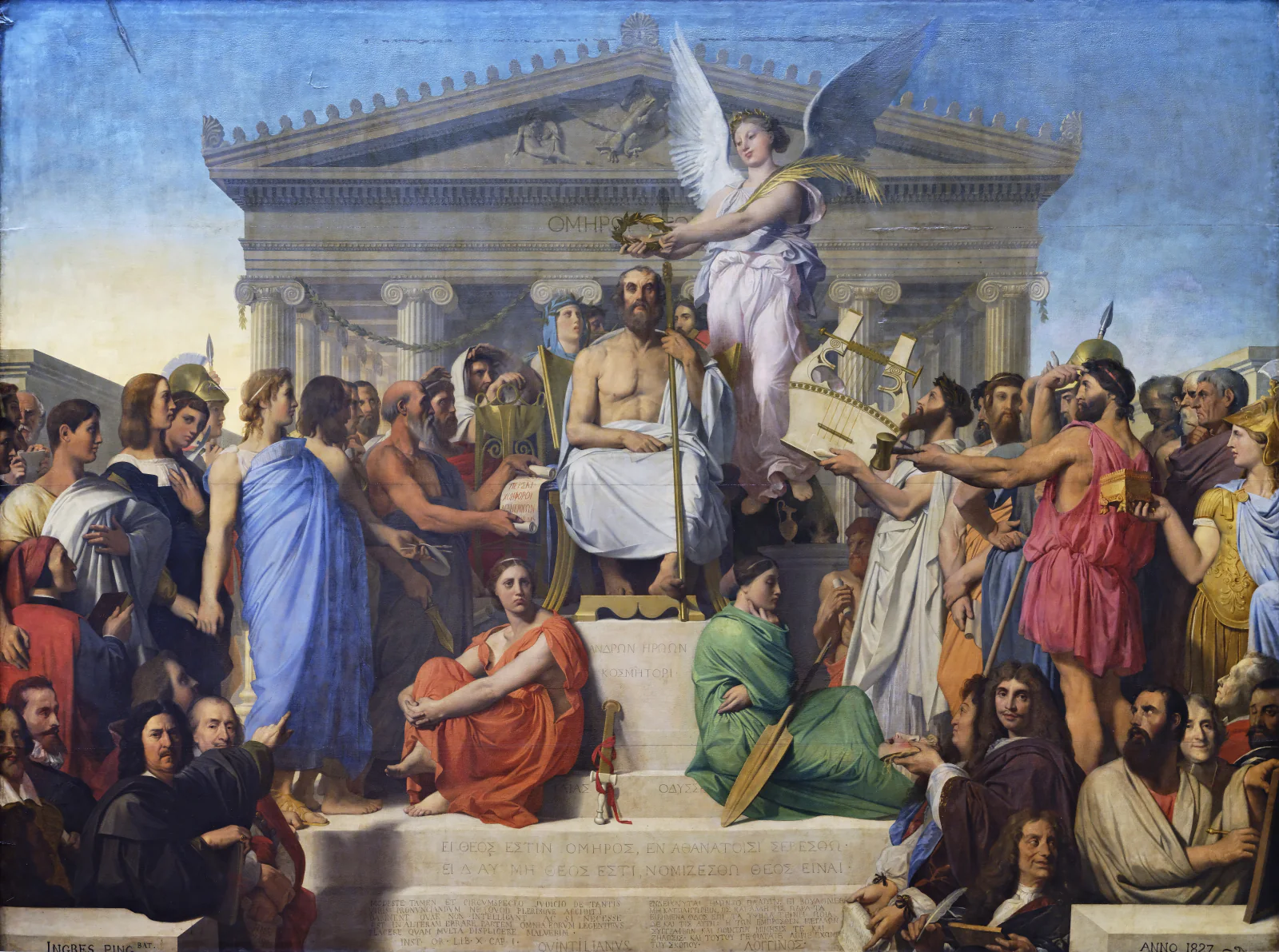

Can Silicon Valley Buy Taste?
Can one buy a cultivated sense of the finer things in life? Silicon Valley thinks the answer is yes. AI can now produce an endless supply of images, songs, and all manner of “art,” and the industry responsible for that glut is now trying to sell you its own curation of it. Jack Dorsey calls judgment and taste the durable human skills left once AI absorbs the rest of a company’s work. Anthropic advertises its latest models as more “tasteful” and “creative.” This year, a company called Taste Labs raised $18.5 million to build a data layer meant to give models taste outright, announcing itself beneath the imperative: KILL THE SLOP.
I want to know what they think they’re killing.
THE MAN OF TASTE
This is hardly the first time abundance has made taste urgent. When Joseph Addison wrote about the subject in The Spectator in 1712, he cited the Spanish Jesuit Baltasar Gracián, for whom “fine taste” was the utmost perfection of an accomplished man.
The pairing was no accident. Taste as savoury sensation and taste as cultivated judgment had been happily married from the start, and nineteenth-century British foodies took the marriage literally. Their “committees of taste” raised food, and the workings of our stomachs, to the level of the fine arts, applying to the dinner table the same verdict-giving vocabulary — eat this! eat not that! — that the previous century had reserved for judging a painting.
So faced with more to consume than anyone could absorb, the Man of Taste distinguished himself by what he chose among it, which is presumably why anthropologists still point out that while every animal eats, only humans have cuisines.
UNKNOWN RULES
The Valley has, mostly without knowing it, inherited the philosophical problem this history produced. If taste is a private sensation, how does it become a standard? The philosopher David Hume argued that some observers genuinely judge better than others, through practice and a delicacy of perception that lets a trained eye catch what an untrained one misses.
Kant went one step further: a judgment of beauty begins as a feeling in one person, yet carries an implicit demand that everyone else assent to it, which is what separates calling something “beautiful” from calling it, say, merely “pleasant.” Both are asking the same question: how do we generalise from subjective response?
Writing in the same year as Hume, the French lawyer Montesquieu described natural taste as a prompt and exquisite application of rules we do not even know. This formulation does a great deal in explaining why taste tempts technologists: machine learning also extracts regularities without requiring an explicit theory of them, which means that if taste really does work the way Montesquieu said, enough examples ought to encode it.
But Montesquieu’s unknown rules remain embodied in a person, and in the history of that person’s attention. Your Spotify may learn which patterns succeed, but taste also knows when success has hardened into cliché, a distinction no amount of engagement data has so far been quite able to capture.
Your Spotify may learn which patterns succeed, but taste also knows when success has hardened into cliché.
KILL THE SLOP
Whether those rules can actually be extracted is a separate question. Some of the Valley’s confidence is just the economics of abundance described above. But some of it is an image problem, which is perhaps why “AI slop” has such currency: undifferentiated matter, plentiful and ingestible; the kind of thing you could feed your dog.
Much AI slop is technically competent while lacking any distinguishing character, and as a recent Times conversation suggested, the industry’s anxiety about it doubles as anxiety about its own “vibelessness.”
Where Steve Jobs was mythologised, this generation of leadership gets mocked as stale, robotic, and, yes, vibeless. The charge cuts deeper than branding, because the models this vanguard builds reproduce it—which is why audiences flinch at AI used carelessly in film, and why Merriam-Webster chose “slop” as its 2025 Word of the Year: a word for cultural production from which almost everything except production has disappeared.
“Digital content of low quality that is produced usually in quantity by means of artificial intelligence.”
—Merriam-Webster
Silicon Valley is right to treat this as an emergency on two fronts: an image to repair and a technical flaw to fix. What it has yet to admit is how tightly the two are bound together. Its chosen remedy will only deepen the problem. A taste layer is structurally a consensus engine: gather a panel of approved tastemakers, extract their judgments, and convert those judgments into signals a model can generalise. What emerges may be more glossy, more ordered, less immediately offensive. But those are also the qualities of the median.
Voilà. Silicon Valley proudly presents: mass-produced taste.